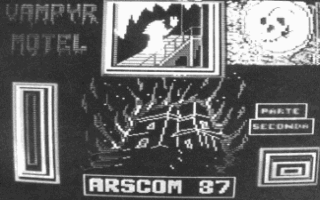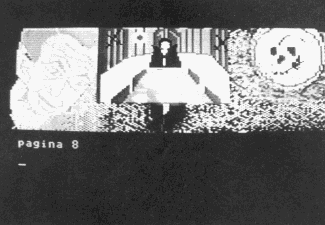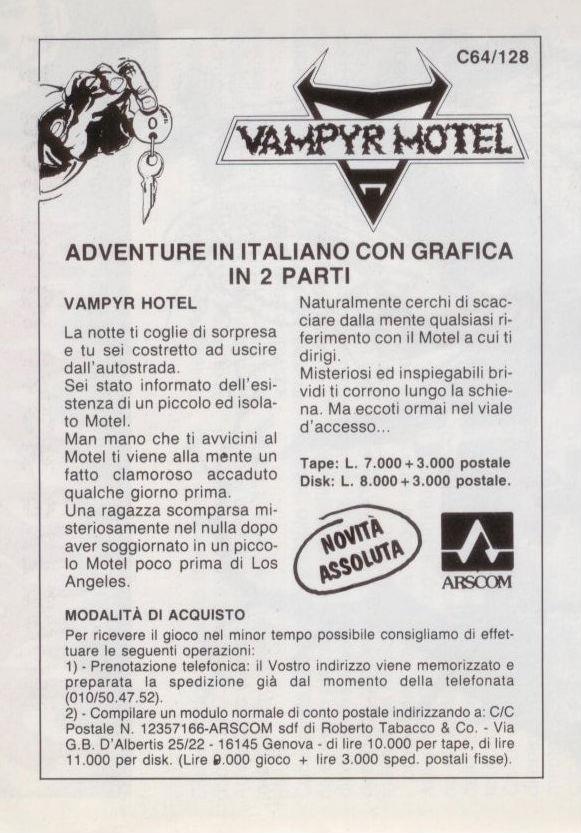
An entry for what was an Italian graphic text adventure which is currently at large. Developed by Roberto Tabacco and Hans Piu, Vampyr Motel was one of Arscom’s final adventures, sold directly by mail order rather than through the company’s earlier newsstand adventure collections. Unfortunately, this distribution method significantly limited its circulation, which likely explains why the game has yet to surface today.
Ready64 notes that Arscom was not actually a publisher but a small Genoa-based development team consisting of programmer Roberto Tabacco and graphic artist Hans Piu. After collaborations with Edisoft, Edizioni Hobby and Softgraf on several successful adventure series, the team briefly experimented with self-publishing through mail order with Vampyr Motel and Raiders of the Valley of the Kings. Sadly, both games remain missing and Ready64 notes the tragic death of Hans Piu in a boating accident during the late 1980s or early 1990s.
A review in Commodore Gazette describes Vampyr Motel as a graphic adventure. Although the reviewer felt the writing lacked the literary quality of Infocom’s adventures, they noted that the graphics helped compensate for the relatively sparse text. The adventure featured a traditional map-based system with movement via the compass directions and a first-generation two-word parser, although the reviewer criticised its rigid handling of commands, with synonyms rarely accepted even where they seemed logical.
The review did praise an interesting feature allowing players to save and restore their progress directly into memory without leaving the adventure, alongside the usual save and load options using external media. The story placed the player inside a gloomy motel consisting of four rooms and a reception area, with a sinister villa nearby. Investigating the mysterious disappearance of a young woman, the player gradually uncovers clues, messages for help and the threat of a looming tragedy, whilst trying to avoid a deadly encounter with the resident vampire.
The reviewer felt the adventure followed an established formula, although deaths were perhaps too frequent and often unpredictable. Nevertheless, they concluded that such trial-and-error gameplay was very much part of the genre’s appeal, hinting that “a few surprises” awaited players at the end.
Thanks to Fabrizio Bartoloni, we have also added an interview with Roberto Tabacco below, kindly translated from an archived copy of the original Arscom website preserved by the Internet Archive:
A number of additional screenshots have also been added. Hopefully a surviving copy of this intriguing adventure will eventually surface.
Contributions: Gamebase64, Fabrizio Bartoloni, Ready64, Archive.org
Supporting content
Gallery
Creator speaks
The production of adventure games in our country
Interview with Roberto Tabacco, manager of the software house Arscom.
The first adventure games in Italian with graphics available on our market were published in a magazine on cassette called “Next Strategy”, whose first issue came out in April ’85.
Since that day more than two years have passed and Arscom, a company producing adventure games in Italian, has continuously improved its products, trying to offer the best of adventure games in Italian with colour graphics. Through the following interview you can better understand the work done by the Genoa-based company.
Commodore Gazette. For the last two games made by you, “Vampyr Motel” and “I predatori della valle dei re” (it could be translated in English as “The predators of the valley of kings”), you have chosen the distribution by post, preferring it to that through newsstands. What is the motivation behind this decision?
Arscom. Users interested in adventure games are profoundly different from those who play arcade games. It is a user preferring a game focusing on the use of reflection and logic than the speed of reflexes. It is a particularly demanding market segment and this is stimulating for us. Those who have already purchased one of our products follow us with confidence, so we tried the direct route: from the house that produces to the consumer, skipping the various editorial distributions.
C.G. How did you make these two new games, what procedure did you adopt?
A. First of all, we made a complete revision of the adventure module; it is a module that is not a real editor, but something that, overcoming all the limits of editors, allows you to advance in a very articulated way, varying and renewing the schemes according to the needs that emerge from the story itself. The plot and the interweaving of the game are treated with particular attention and we always try to propose questions that can be solved with a little common sense and logic. We are against abstruse and arbitrary solutions. An interesting detail that I would like to stress concerns the fact that in building a story we use the contribution of film and television scriptwriters, which allows us to obtain a solid narrative structure.
C.G. Why do your products cost so little, don’t you think this could be harmful?
A. For the moment, and for these two games, we have chosen a policy of particularly interesting prices, not for a greater competition with other producers; it is, more simply, a special offer, aimed at encouraging even those who have never played with our products so that they can know and appreciate them. The price is certainly not an indication of the value of these programmes.
C.G. We mentioned the creative phase of the game, tell us now how your adventure is born.
A. First of all, you choose the story on which a sort of textual storyboard is built with the most important movements. Then, we add the various details, so as to create the necessary tension line in the most important and exciting points of the game. We tend, in practice, to create a double or even a triple story that continues independently from the main plot, but that does not lead to the solution.
We work a lot on the narrative development until we are completely satisfied with the results. When the game has been completed we move on to testing, for which we always invite people from outside our staff. At this stage the game is questioned, taking into account the reactions, gestures, expressions and comments of the players invited to the test. The program is then retouched and refined before being delivered in its final version to the public.
C.G. “Vampyr Motel” can be found in two versions, one on disk and one on cassette, is there any difference between the two versions, how come the same thing was not done with “The Raiders”?
A. “Vampyr Motel” was born as a game on cassette. We then realised that many users own the disk drive and are often inclined not to consider buying a cassette game. For this reason we decided to make a version of the game on disk drive that is identical to the previous one. As for “The Predators”, instead, we decided to start immediately with the disk drive, so that we could make use of special management such as the use of relative and sequential files. The game, obviously, is wider than the previous one, thanks to the possibilities offered by the use of the disk. It is a program of considerable size, very articulated, able to engage the player for a long time. The results obtained have given us great satisfaction.
C.G. Proposals for the future?
A. There are important news that we have been working on for a long time, but for the moment everything is top secret.
Related articles
Vampyr Motel review from Commodore Gazette 1987 issue 06
After publishing several adventures through different publishers, the Genoa-based group Arscom is now on newsstands with a monthly magazine of Italian adventure games called Epix 3001. Arscom has also organised a mail-order sales network for its products, following a route now being adopted by many authors and publishers. This is further evidence that the Italian public is showing increasing interest in this style of home computer entertainment.
Arscom’s products for the Commodore 64 and 128, available on both cassette and disk, are accompanied by a lengthy letter to the user discussing software piracy. The company rightly offers a kind of loyalty reward to those who, instead of allowing illegal copying of the game they own, encourage new users to purchase original copies. It is a commendable initiative, one that is becoming more widespread and which we fully support. Protecting the creators of original software, particularly Italian software, is essential if the quality of such products is to continue improving.
Turning to the game itself, which we examined in its disk version, the program loads in two separate stages through an initial menu that is not particularly game-like in appearance. The second part can only be accessed using a password obtained by successfully completing the first.
Vampyr Motel is a graphic adventure featuring half-screen illustrations accompanying text descriptions that are perhaps occasionally a little too sparse. It is certainly a long way from the evocative, almost literary quality of the writing found in Infocom adventures. However, in some situations the half-screen graphics help compensate for the lack of detail in the written descriptions.
The game is map-based and movement is carried out using the traditional compass directions, although movement verbs can often be used as well. The first-generation parser analyses only two-word commands, forcing the player to use an almost “artificial” language, something that fans of this generation of adventure games have nevertheless become accustomed to. Even so, the rigidity of the parser is noticeable. Synonyms are almost completely excluded, even where they would logically be acceptable.
In addition to the traditional system commands – I for inventory, S to save to external media, and L to reload a saved game – there is also an interesting option to save (SR) and restore (LR) the current position directly into memory, allowing the player to continue without leaving the adventure.
The protagonist of Vampyr Motel finds himself in a gloomy motel consisting of four rooms and a reception area, with a sinister villa standing nearby. He recalls the mysterious disappearance of a young woman. Curiosity, together with the need to survive, drives him to explore the various rooms, finding keys, discovering messages asking for help, and uncovering clues to a tragedy that appears about to unfold – one that our brave hero hopes to prevent. Throughout the adventure there is always the danger of encountering the vampire without having any means of neutralising it, in which case the protagonist’s death is inevitable.
The style of gameplay is by now well established, although, at least to our taste, the player’s deaths are perhaps too frequent, highly unpredictable and often result from situations that are not entirely justified. But that is, after all, the spirit of this kind of game: try, fail, and try again.
At the end… a few surprises await.
Update history
28/07/26 – Complete update of review and added colour screenshot and scans.